
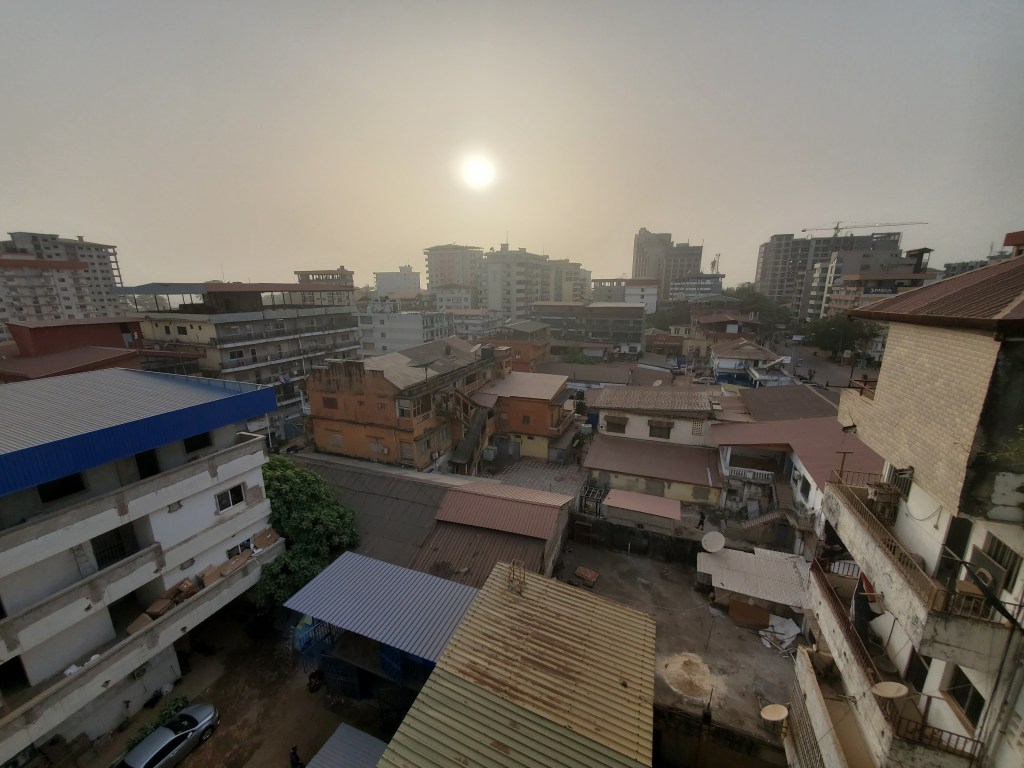
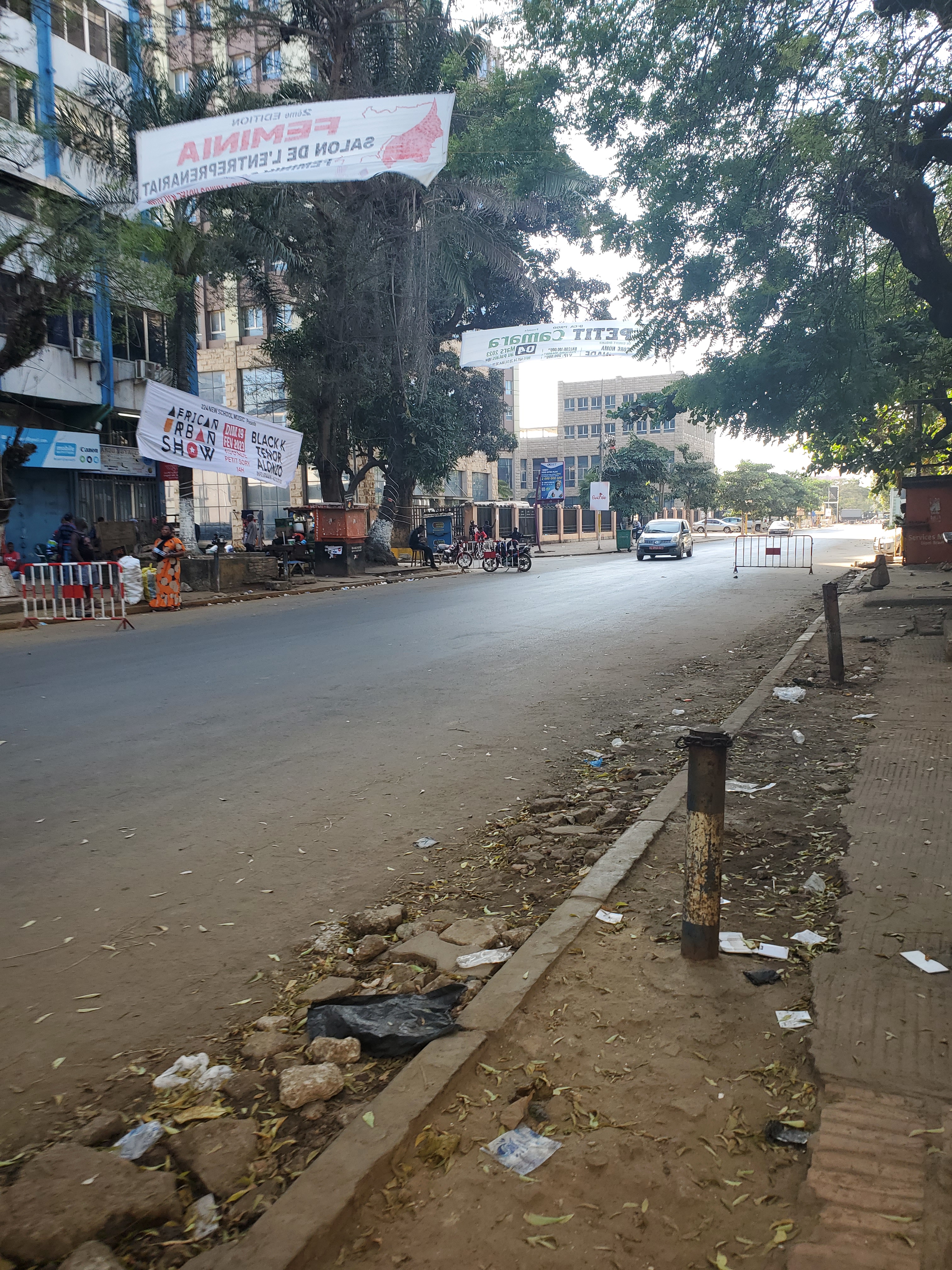
In my final days, I spend the slow hours wandering and witnessing life on the streets. Through the door of my hotel lobby is the heart of Conakry. The late afternoon sun casts pale yellow light over the intersection. Bustling and restless, beyond my hotel stoop is an endless parade of people, vehicles, and life. Men loiter around vendors, shining shoes or hauling wares. I am scarcely outside when several try to catch my eye. “Monnaie?” they ask, rubbing their thumbs and fingers together. I am ever cognizant of my status as an outsider here. Hopping from the hotel stoop and onto a worn sidewalk, I cut away from the crowd.
As I go, motorcycles slow down to ask, “taxi?” or honk in a way that inquires the same. I decline by waving my hand if I’m feeling polite and shaking my head if I’m not. Another driver within view of the first pulls up seconds later to ask the question – as if I’d only just declined because of some issue with the other driver. I narrowly avoid a motorbike that cuts in front of me to park on the sidewalk. It pays to be assertive here. A man in a sharp blue suit steps out boldly to hail a taxi, then enters the vehicle having an important conversation on a cell phone.
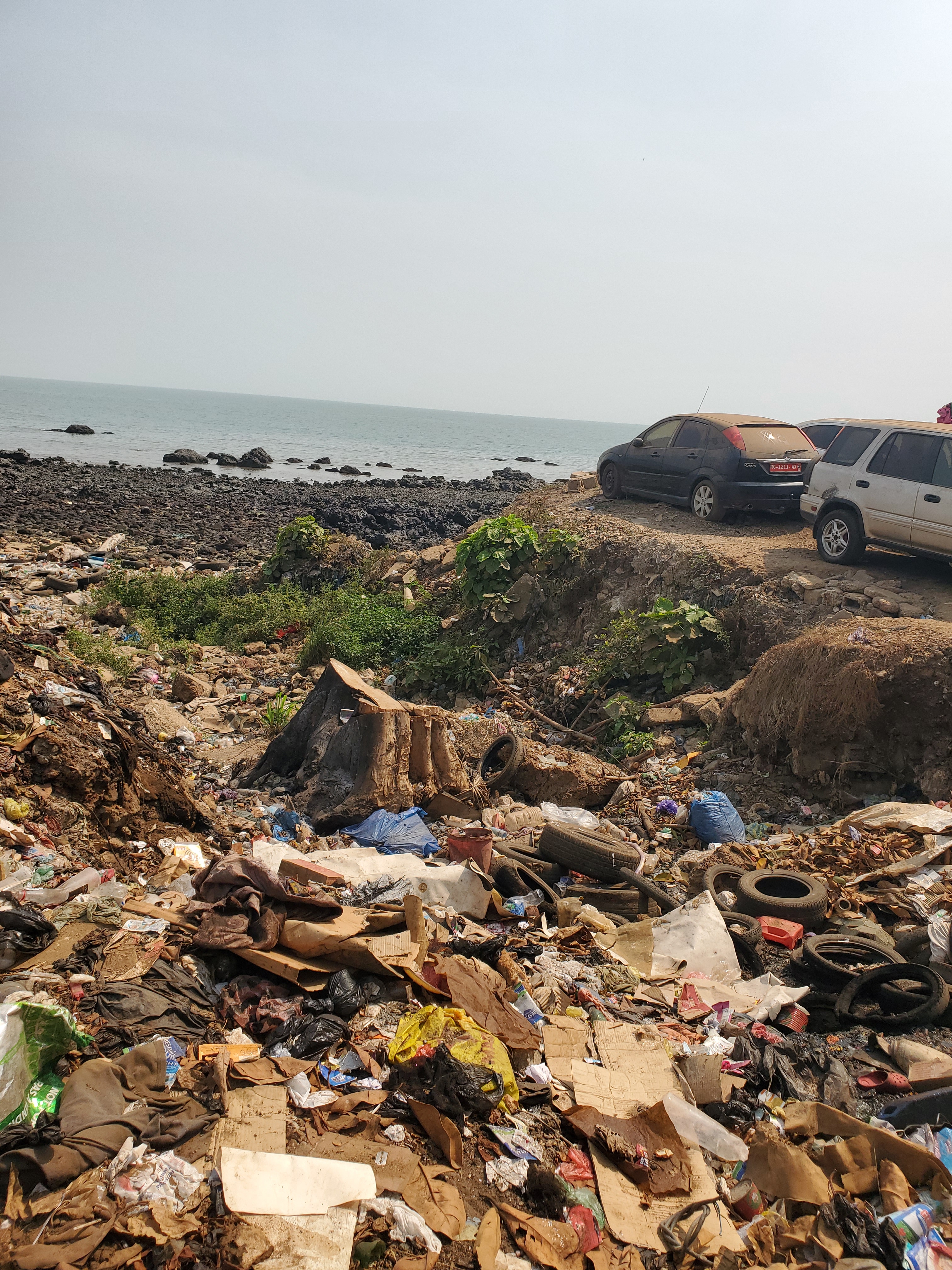
The city seizes the senses. At an intersection, motorbikes and cars blare their horns to announce their intention of turning. A soccer ball whizzes passed my head – a group of kids are playing a game that seems to be migrating down the street – and when it lands in front of me, I pass it back, the old, deflated ball giving way as I kick. I hop over a river of dark liquid receiving tributaries from a dumpster nearby, inhaling a medley of rotting food, human waste, and the saccharine effervescence of something fermenting. On the same block, a man walking his dog stands by indifferently as his companion defecates in the middle of the street. Someone yells at him. He shrugs and walks away.
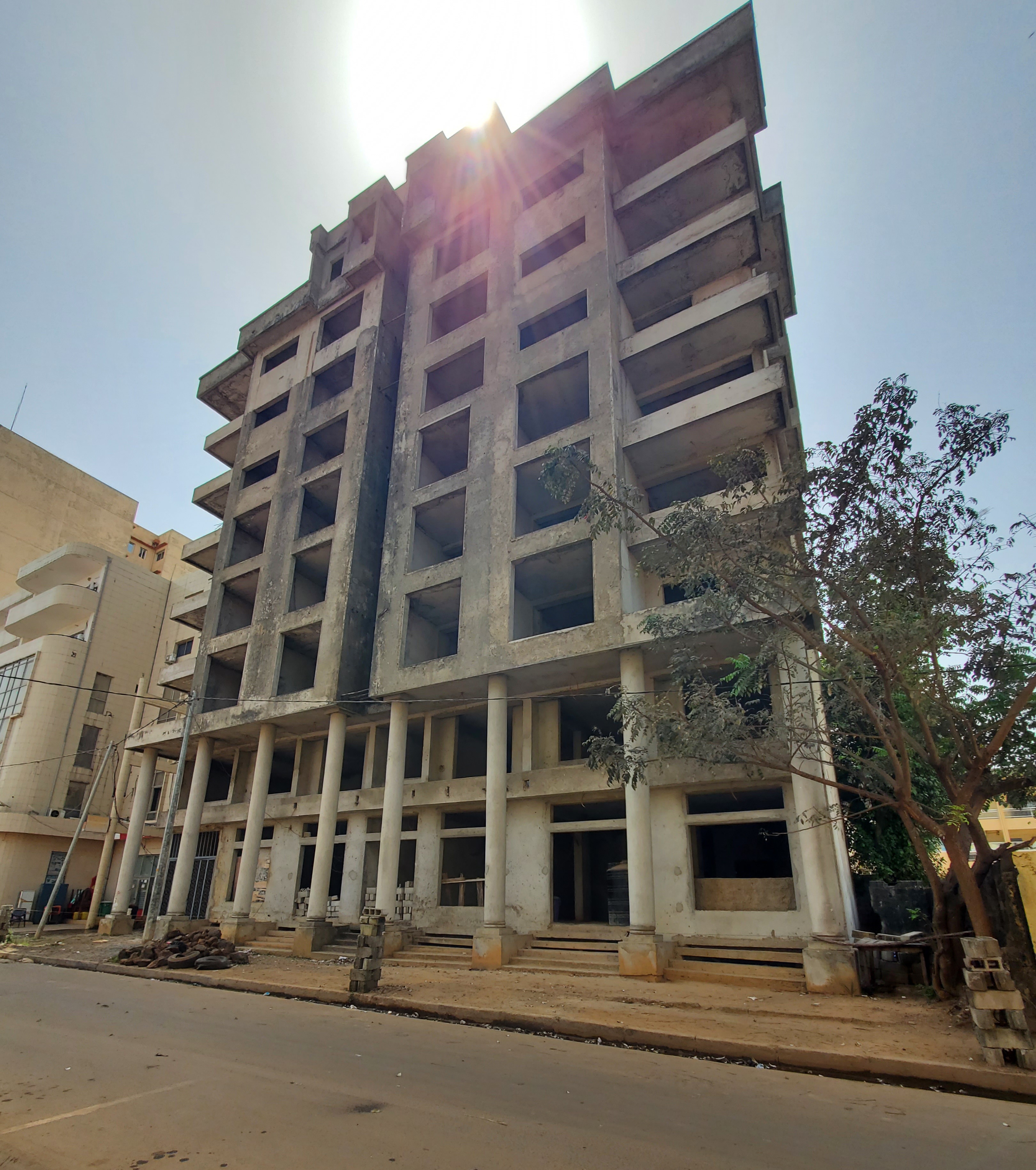
Each new street boasts its own construction project. Like a specter of economic promise, every hundred feet, the skeleton of another commercial building or apartment complex reaches towards the clouds. Some of them have crews scattered among the half-built floors; many appear abandoned, collecting dust besides piles of iron beams and crushed rocks with a regularity that poses the question whether it’s simply cheaper to begin the project again then correct an erring first draft. Ten years from now, will they still be here, waiting to be finished, or is this the face of a city being reborn?
I turn a corner and my eyes lock with a man sitting on a crate. “Monnaie?” he asks. It is impossible to respond to all these requests. Pronounced “money,” the French word for “change” is the most common these entreaties start, but there’s also “mon ami,” “patron,” and their English equivalents, “my friend,” and “boss;” sometimes they begin “monsieur” and sometimes just “blanc!” (white guy). Whatever the form, all remind me of my status as an outsider and reflect the same basic assumption: as a foreigner who has traveled from another country, I have access to money they do not.
Three young girls dressed in conservative school uniforms start trailing behind me. One of them grabs my arm. “Papa,” she says, “s’il te plait,” using the informal form of address usually reserved for family or friends. I shake my head. Most adults (always men) will leave you alone after an attempt or two, but the kids, desperate with hunger, often persist. She follows me down the block before giving up the chase. At the corner on the opposite intersection, a pair of siblings pushes a visibly disabled child in a wheelchair. I feel worse than ambivalent as I pass them, wondering if that child’s malady might have had a different outcome had she been born somewhere else – but I’ve scarcely walked a hundred meters and the need is staggering here.

On the next block is a mosque, which casts a shadow stretching to the opposite sidewalk where families sitting in lawn chairs line the road. Crowds arrive early to socialize with their neighbors: religion is the center of community here. A trio of older men dressed in traditional Muslim robes approach from the opposite direction. They converse without taking notice of me, forcing me to retreat into the road so that they may pass. An elderly woman seated nearby sees and says something that seems friendly. I smile and wave back.
Not far from the mosque is a market. Dried fruits, cured meat, and handmade clothes hang from stalls. I swim through the crowd, a sea of foreign dialects around me.Mothers scurry after toddlers, who run towards flashy displays of noisy toys; other women cruise through the crowd balancing baskets upon their heads with unwavering grace. Many wear veils that cover their faces. Teenagers in T-shirts with random English phrases sell clothing with American flags. The more I look around, the more red, white, and blue I see. Stickers on motorcycles, air-fresheners hanging in beat-up cars. Jackets and hats with American sports teams and slogans. I once asked one of the residents about this fixation on US culture, and his reply reminded me of something I’d heard once before, in another country: “the people here love the idea of the American dream. They love the possibility that there is a place where you can be anyone.” What an idea. I didn’t bother correcting him. Maybe they need the American dream like we do.
Beyond the market, a huddle of soldiers post next to a military building. Near them is a man without legs. I’ve seen him before. Holding flip flops like sandals for his hands, daily, he hops along to the same spot and then sits unimposingly on the sidewalk. The first time I passed, he greeted me with a toothy smile and an outstretched palm; I’ve since admired from a distance, my feet unconsciously weaving away from him to avoid the necessity of having to drift by without donating yet again. Despite the marvel with which I behold him navigating through the streets, I have yet to extend my hand to his. On each block, there is someone else posing the same question: how could I give to only one of them?
The buildings give way to smaller homes as I enter a residential neighborhood. Ancient trees break through the concrete on either side of the road, coming together to form an arch. Seeing the children run about, my pace relaxes. I pass a chicken trailed by a chain of chicks, dogs lying under cars, goats followed by their kids, and occasionally a cat. Here too, there are street vendors on every corner, but also families cooking, doing laundry, huddled around a TV, and more kids playing soccer in the street. Somebody has tied a steer to a tree; as a crowd gathers around, I wonder if a spectacle is unfolding. Every now and then a car plows through the foot traffic, parting the crowd with its horn, but the neighborhood quickly reassembles.
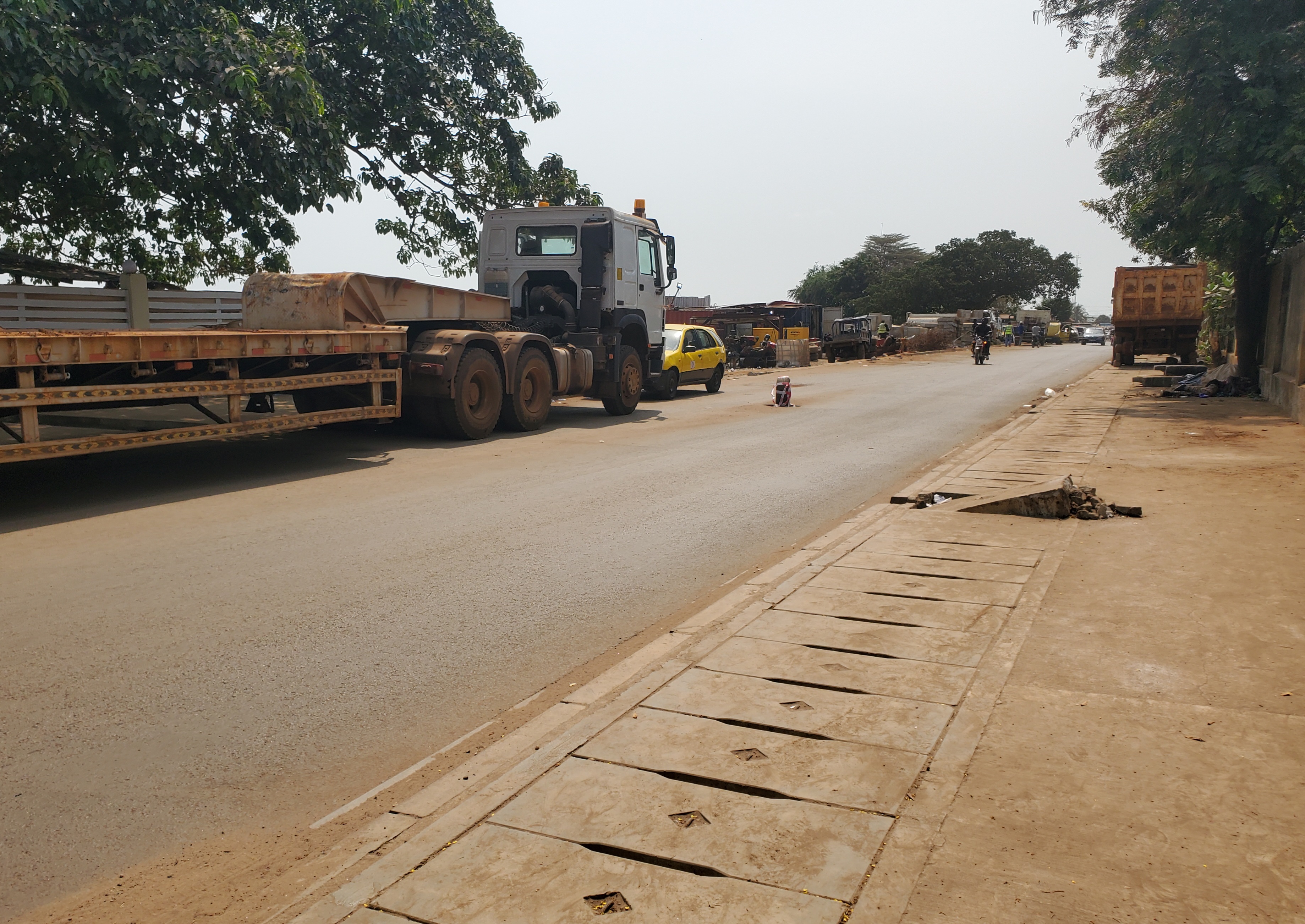
You can learn something about the safety and vibrancy of a community by the number of kids playing out in the streets. Any which way you look, there are countless children, chasing each other, kicking deflated balls, or in the shade, watching soccer games on old TVs. While many of them are doing chores and a disturbing percentage of the city’s youth is out panhandling during school hours, most are just out, being kids. A trio of boys, just old enough to start strutting, approach me confidently from the other direction, and as we pass, the boldest extends his hand to give me a high-five. I find myself smiling. Then a toddler waddling after a chicken tumbles over; a parent nearby walks over to lift her back up, brushes her off, and after a kiss on the forehead, the kid runs off again.
I leave the neighborhood for the final time. Beyond the homes, on a street that runs parallel to the distant coast, the motorcycles race by until they reach a large stone wall that hides a cemetery beyond it. A lone guard stands post at the entrance, letting cars with tinted windows pass. Majestic trees emerge from behind the wall and climb into the sky, towering above the neighborhood and casting shadows on the soil below. Giant vines hang from their mossy branches, dipping towards the earth then rising back into the canopy like wayward spirits. In this corner of the city, the greenery erupts from the concrete city in solitary tribute to the west African wilderness.
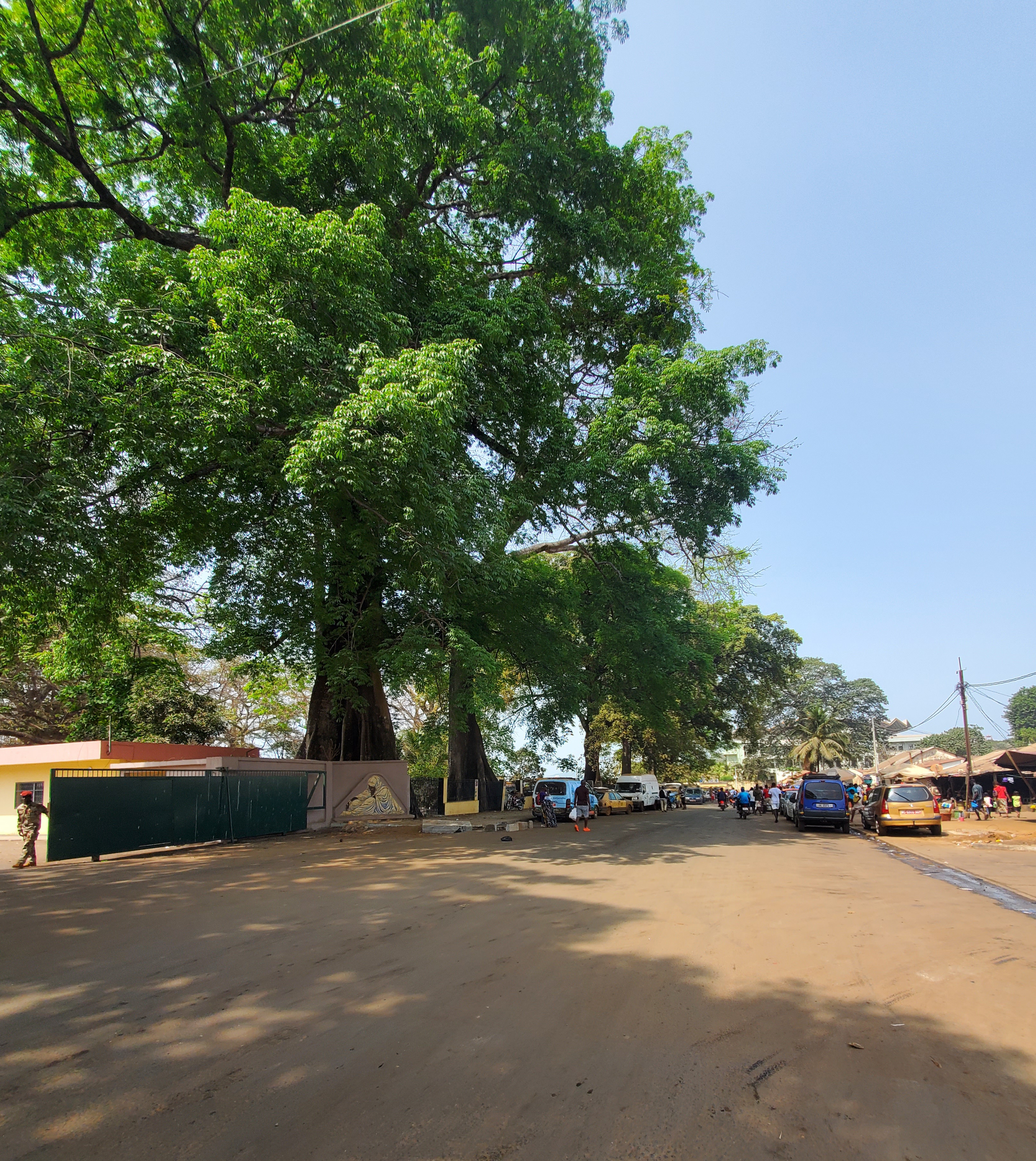
As I leave the cemetery behind, just beyond, there is a glimpse of the shore. Old motorboats with rusted propellers and canoes of aged wood rest where the remnants of the commercial life of the city have crept toward the sands and stretched into the Atlantic. The water glistens from a distance, though I know the oil spilled from nearby shipping tanks plays tricks upon the eyes. Then the view is interrupted by an even larger wall. Imposing slabs of concrete thrust themselves from the earth between watchtowers where bored guards wait. Somewhere on the opposite side of them, nestled among manicured gardens, is the Presidential Palace, standing among the populace yet completely isolated from it.
Turning now back toward my starting point, I’m simultaneously struck by the shadow siblings of hope and despair — despair for the immensities of the healthcare inequities and poverty that I’ve witnessed, for the squandered potential of the youth whose lives have been senselessly lost, for the hardships that some of the citizenry must navigate daily to make their way in this harsh world. Yet through all the world’s cruel indifference, a light cuts through the shroud and illuminates the possibility of a brighter future. Hope rises above the turmoil: that those construction projects reflect a population building towards a higher future; hope that through the injustice and ugliness of it all, something so beautiful as community, love towards one’s neighbor, and dedication to one’s family could still shine so brightly as cherished values, animating the dusty roads and cracked streets of Conkary.
When I think back to my time here, it is this life on the streets that I will remember. While my short residency has offered but a snapshot of life in Guinea, the way that this community shares public spaces has allowed me to glimpse the soul of the culture. Of course, there are many limitations to my observations, and I worry that I have, at times, focused too much on despair. Yet the dignity that I have beheld in so many here is tribute to the fact that while the chaotic cosmos may always pose the need for charity, through this need, there also arises a particular strength and beauty. Only the courage to see past the array of disordered first impressions can allow us to find the patience necessary to understand and learn from our fellow humans. As dusk approaches, I complete my trek back to the hotel. Before returning to my room, I ascend to the roof. The sun is already falling behind the horizon smog, scattering shades of rust across the urban sky. In the area, one hotel in particular juts from the skyline, towering above the other buildings. I see locals on their roofs watching the sunset, participating in the daily ritual of rest and renewal. Yet scarcely have I seen a soul pass through the glass doors of that enormous hotel, and never the silhouette of a guest on its ornate tiered roofs. A cathedral of tourism, slightly out of place, just like its visitors.
///
 neuromantic.net