
Mes chers amis et famille,
By the time I arrive each morning – my commute a couple dozen steps from the opposite side of the compound – there is already a mass of patients and families lined up outside the hospital. They’ll spend the day waiting for their turn, prepared with baskets of food and small squares of carpet they’ll kneel on to pray at the customary times. There are no appointments; first come, first seen. I smile at a small child running about, who pauses to look up at me, and feel their eyes on me as I enter.
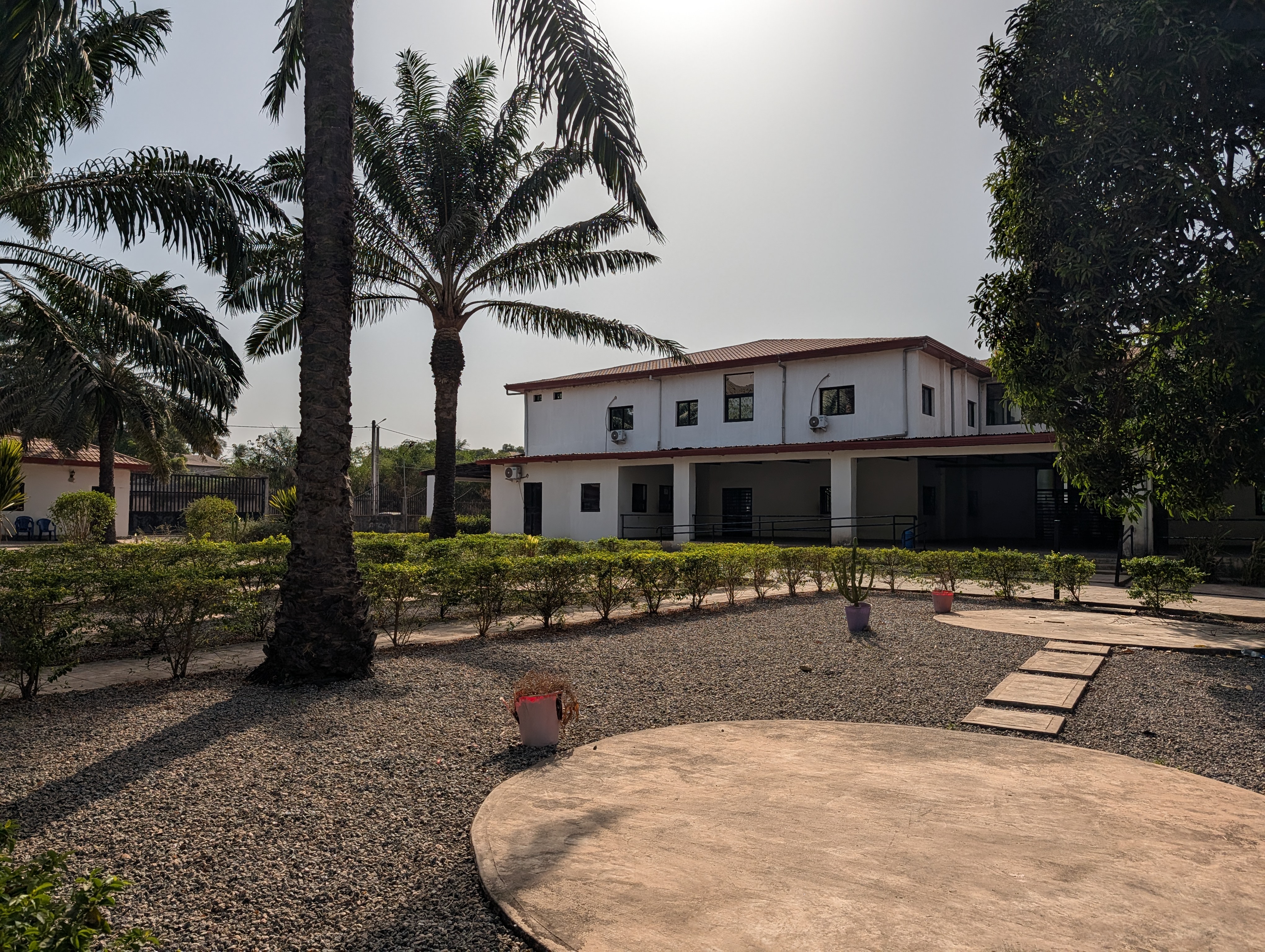
One wing of the two-story building is “Urgances” where the sicker patients are brought for evaluation and stabilization. Functioning as an emergency room (but only during business hours: there is not staffing or capacity for overnight observation), patients there will receive IV treatments and oxygen therapy. While their capacities are limited, in the area, Urgances is a last line of defense before a patient is sent to the country’s main hospital, Donka, a short 2-hour drive south into the capital. There are no ambulances or EMS, and no matter how sick the patient, they must fight through the traffic funneling into Conakry the same way as everyone else.
My new office is on the other side of Sacré Coeur among a hallway of clinic rooms where the local pediatricians will see other children. I arrive to a short list of patients that’ll multiply as new ones show up at the hospital and get added-on to my day. The hospital maintains a growing roster of patients with neurological illnesses, and when a volunteer like me comes to Dubreka, they’ll schedule a batch of them in advance. Despite the challenges posed by the ephemeral electricity supply to the area on the use of electronic medical records, the hospital is quite organized, keeping a running list of the medications the patients should be on so it can ration its precious supply of anti-seizure medications and order (or attempt to order) more when running low.
Today, I am working with one of the newer residents, who is there to learn and help me write prescriptions, and a hired translator, who compensates for my broken French and speaks a local dialect. Together, they bridge the distance between the patient and I arising from the language barriers and my own cultural misunderstandings. Nearly every visit begins the same way: the patient arrives with their family (most often, their mother, but sometimes also an older sibling, and less often, their dad), I’ll start with an open-ended, “How can I help you today?” to which the usual reply is, “They called me to come because you were going to be here,” leaving me with no conception of their needs or medical problems, and the task of spending the following minutes reconstructing their histories and putting together the pieces of a diagnosis that may or may not have been shared with them. Compared to home, where our medical model has increasingly focused on shared decision making, the culture here is remarkably paternalistic. The families, left without the recourses of second opinions, patient advocacy, or the legal system, for the most part trust and defer to whatever guidance they are given with or without the opportunity to ask questions.
A family arrives with their 3-year-old child and a chief complaint of inability to walk. As mom sits in one of the colored plastic chairs opposite my desk and props her child on her lap, the first things I notice about him are the prominence of his large head and the subcutaneous line that snakes behind his ear down below his shirt collar, which I recognize as a device called a VP shunt used to divert excess ventricular fluid within the brain into the abdominal cavity. As with most visits concerning some kind of developmental delay, I focus my initial questions on the pregnancy, birth, and postnatal course. They tell me that after their son was born, he had surgery here (pointing to his brain) and here (the lower spine). He had some kind of problems, they tell me, but aren’t sure what they were. This sort of answer is ubiquitous here: a patient (often an infant) will be hospitalized for maybe weeks at a time and all the family will be able to tell me about the illness is that their child was receiving “treatment.”
Fortunately, by this point in my short career I’ve seen enough to recognize that the patient was likely treated for a buildup of ventricular fluid called hydrocephalus and a spinal cord dysmorphism called spina bifida, and that this combination of findings in a newborn is suggestive of a syndrome called a Chiari 2 malformation. I examine the child and deduce that there were injuries to the nerves traveling from his spine to his legs during the surgical repair – which is not an unexpected complication, but one that will likely prevent this child from ever being able to walk.
So here we are: me, the foreign specialist, and this family, who have traveled perhaps hours and waited in line for more, with hope in their eyes that I will be able to somehow fix this problem. Yet like many genetic or early life insults to the nervous system, the deficits, once established, are permanent, and even back home, there’d be no magic treatment I could offer them.
I show them a schematic of the brain and the spinal cord, and outline the course of peripheral nerves leaving the lumbosacral spine to the lower extremities. I give their son’s condition, a name, which I write on a paper and give to them, and then make arrangements for their child to be seen by a physical therapist. While the nerve damage is done, I tell them, my hope is that with time and therapy, their son may recover some function. Even after I share that I fear he may never walk, they thank me, graciously, before leaving the office.
There is so much that I cannot do here, and there is so much that I can do.
A la prochain,
Le Gringo
//

