
Spinal Muscular Atrophy (SMA) is a congenital illness of the nerves traveling from the spinal cord to skeletal muscles. Manifesting in the months or years after birth, it afflicts these neurons, causing progressive weakness in all motor functions and eventual death by respiratory failure. In its classic forms, the condition was universally lethal, until 2016, when the FDA approved a genetic therapy that could cure the condition – if it was recognized shortly after birth and treatment begun imminently.
A mother returns for a third consecutive day with her three-year-old son, who’d initially presented for my evaluation of isolated regression in his motor development. He’s back again to continue treatment for the second pneumonia we’ve diagnosed in a month. Even as he learned his first words and then later began stringing them together into sentences that would make any parent’s heart melt, his first steps became increasingly unsteady until gradually, he stopped walking, and then crawling not long after. His history and examination are suggestive of SMA – which back home, would have long ago been diagnosed on a routine newborn screen and treated with gene therapy.
In this indifferent world, it is among the cruelest injustices that the circumstances of one’s birth may dictate who lives and who dies.

The mother stands in my new office, her son fastened by a blanket to her back. Despite the tight, practiced wrapping, his neck and thinning torso appear loose and floppy. Today, my task will be to share the most likely diagnosis with the family. With the help of an interpreter and the pediatrician shadowing me for the day, I speak in broken French and English, which are then translated into the family’s native Pular. This strange game of telephone has less than high fidelity and creates a situation where it is only mom and I who are unable to understand everything said in the room.
On a computer, I pull up images of the brain and motor neurons traveling from the spine to the muscles. I slowly explain how these structures are related, and how her son’s nerves are very, very sick. While the confirmatory test for my suspicion doesn’t exist here, I am worried enough to disclose my fears. I tell her I believe he will continue to fall sicker.
I write the likely diagnosis on a slip of paper, giving a face to the vague worry that’s brought her here. Offering referrals to physical therapy and nutrition (so we can support his strength for as long as we can), I then recommend they see a speech-language pathologist to evaluate his swallowing – because after two pneumonias in a month, his lungs are already reflecting problems. There’s a blood test we can do to rule out something else, something treatable – but I expect that the test will be normal, meaning for him, there will be no cure.
All of this I share through the interpreter, pausing after each successive blow, before seeing what she’d like to ask me. When she responds, the pediatrician jumps in, answering questions faster than mom can ask them. I cannot understand their exchange. The mother appears to take the information stoically; I feel as if I’m the only person in the room who wants to cry. Maybe it’s because I can’t read her face, maybe it’s because I’m the one with the clearest sense of where this is headed, maybe it’s because the premature death of children is an everyday thing here. I don’t know.
When their exchange concludes, I turn to ask my interpreter if the mother has understood. He nods solemnly. Mom turns to leave – looking at me before she goes – and says “thank you” in French.
The others begin stirring towards the door before the heavy silence can set in. “I’m hungry,” the pediatrician says, before leaving. I slowly gather my things, turn off the lights, and make my way out.
***

***
Trying to be a better version of myself, I seize a fleeting impulse and go running right after waking up. It’ll be easy enough to retrace the route I took with the others last week, I figure, and prove myself wrong almost immediately. I soon lose the trail, running through dusty streets without names and backyards where people hang laundry, placing faith in my internal compass before it gets too spun around to take me home.
Passing a group of small children for a second time, they seem even more excited to see me again. I stand out as one of the few white people around, and for the most part, the community seems to embrace me: the children wave or give confident little fist bumps as I pass, a guy working in a ladder yells “thank you.” I find my way back eventually, feeling lost and found.
Later in the afternoon, I wander off to sit on the far side of the hospital, near a concrete wall fence that separates the medical compound from asoccer field. It seems most everyone has come out to watch the game. The players are fantastic: their young, healthy bodies bound with endless energy, back and forth and back again. From behind the yellow team’s goal, I can see three sides of the field lined with nearly the entire community. Then there’s me, on the other side of the wall, watching along.
A player from the pink team kicks the deflated ball out of view and someone in the crowd tosses in another one; a player gets slide-tackled, their teammates cry foul, they push one another – but the game plays on (pausing only for the occasional car driving unceremoniously across the field) as the sun falls peacefully toward the horizon.
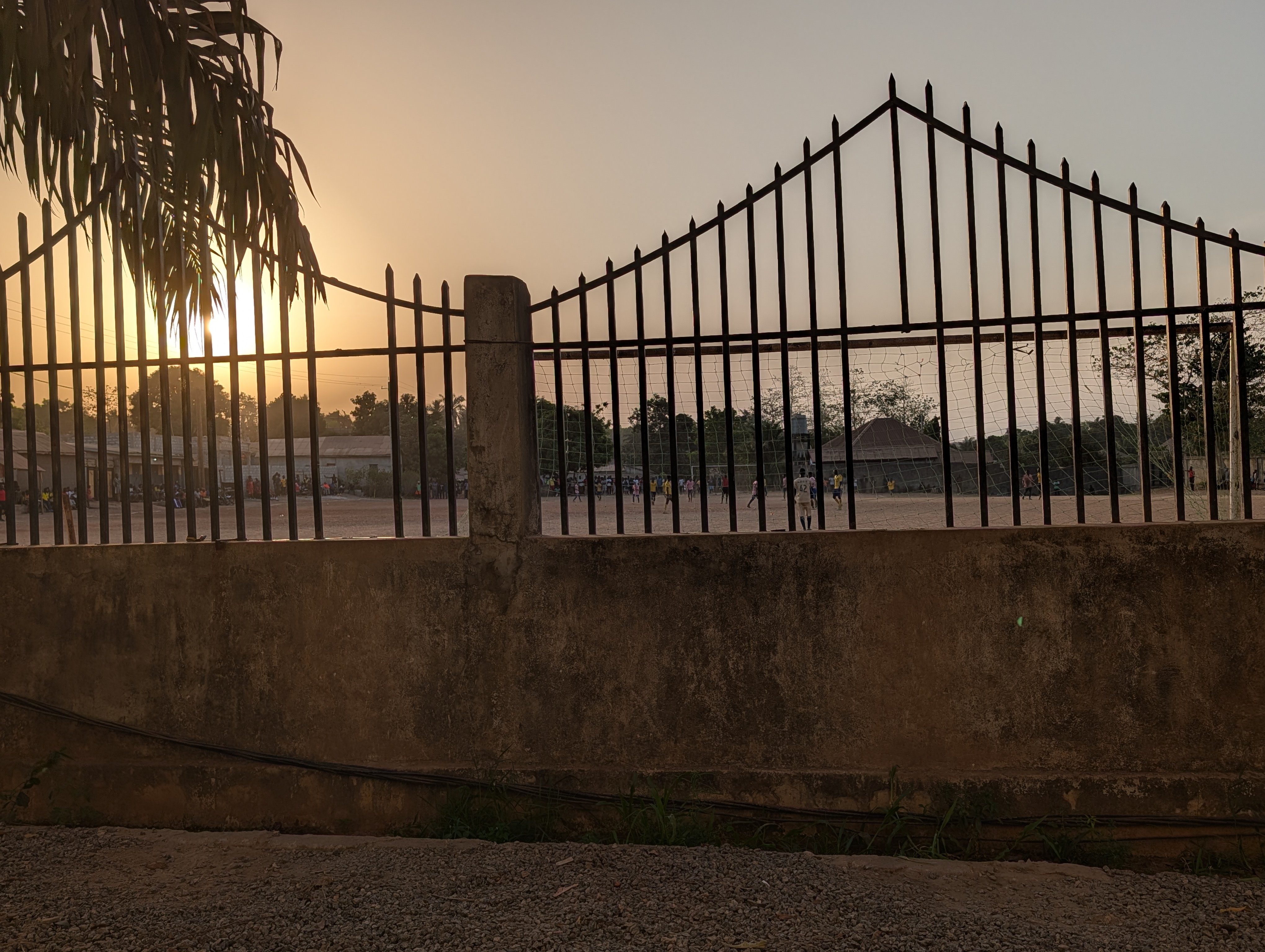
As I sit, spectators passing behind the goal wave or give a thumbs up, correctly assuming I’m here to work at the hospital, my skin betraying my status as an outsider. I wave or smile back. In a week from now, I’ll be gone. That strange feeling: to be somewhere for the last time, knowing you will soon be but a memory, a ghost there. And how many more patients…
Despite the fiercest efforts of the players, no one scores. The players embrace, remove their jerseys, and become one again. Crowds disperse as the sky grows dark, walking back to their single story, single family homes. I retire to the guest house, my temporary stay here.
///

